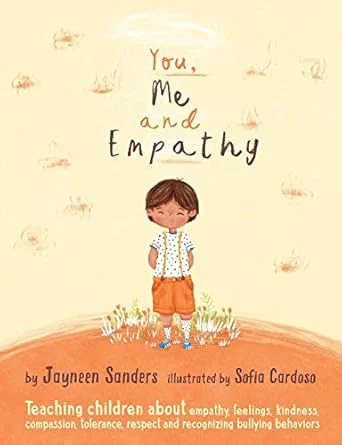
Cover of You, Me and Empathy
You, Me and Empathy
📚
Compassion 1st & 2nd Grade

Book Guide

You, Me and Empathy

A story that explores compassion and opens a conversation with your child.

★★★★★ Loved by families
This book teaches: Compassion. seeing past difference to offer kindness.

Before, During & After Reading

Guiding Questions for Parents.

Definition: The ability to feel what others are feeling and the action of trying to help them with their troubles.  In short:  Feel what others feel. Summary: Students will enjoy this narrative poem about empathy. The narrator shares lots of examples about noticing what others are feeling and what to do to help them. Main message: everyone has times when life is difficult, and because “we’re all on the same side,” we should be willing to try to understand. Don’t hesitate to show that you care!     Lesson Objectives: 
  1. Students are more willing and able to practice empathy towards others. 
  Guiding Questions: 
  1. “Sometimes you feel just like me.” Have you noticed that other people have some of the same situations and feelings as you? Can you give an example? 
  2. How are you the same as a sibling or a friend? 
  3. How are you different from that person? 
  4. What makes you happy? What makes you sad? What makes you worried? What makes you mad? 
  5. Do you think moms and dads need hugs and kind words from you sometimes? Can you remember a time when you gave them a hug because they needed one? Why did they need a hug?  
  6. If you get hurt, how would you like someone to help you?
  7. Did you ever ask someone who was alone to play with you? What happened? 
  8. Do you remember a time when you were afraid of something, like the girl who was scared to go down the slide, and now you’re no longer afraid? What helped you? 
  9. The bully in the story was sad when he was bullied. How did that help him stop bullying? 
  10. If you see someone today who’s obviously upset and needs a friend to talk to, let them know you’d like to help. 
🌿   Virtue Connection: Compassion means feeling what another feels and choosing to act.

Hands-On Practice

Activities for This Story.


Activity: “Stand in another’s shoes” is the name of this community building activity. Student pairs take turns tracing the other’s foot and then respond to prompts that help them to get to know each other better. They are guided in a discussion about the meaning of the phrases “stand in another’s shoes” and “to have someone’s back.” 
  Prompts for “Stand in another’s shoes”: 
  1. favorite color
  2. birthday month
  3. favorite activity
  4. favorite subject 
  5. least favorite subject
  6. favorite food
 

Materials needed: 8” x 11”paper with prompts typed on one side, blank on the other side (one per student); writing materials 
 

Directions: Hand out the papers with the prompts. Put students in pairs. Introduce the activity: “‘Stand in another’s shoes’” is the name of this activity. Have you ever heard that expression? [pause for responses]. Today we will do an exercise that will help you understand that phrase better. Notice that one side of your paper is blank, the other has a list of prompts that you will be using. After each prompt is a space to write a word or two. Begin by tracing your partner’s foot on the blank side of their paper. Using the paper with the tracings, student #1 writes on student #2’s paper and vice versa. I’ll read the prompt, then you take turns responding and writing the answers on your partner’s paper. When we’re all finished, we’ll take turns reading what we wrote to the whole class. This way, you will all get to know one another better!” Guide students to read what they wrote. 
 

Wrap it up: Ask, “what was it like to learn even a few things about someone else? [pause for responses] When you get to know another person, even a little bit, you will be more likely able to understand them better. To really stand in someone else’s shoes means that you “have their back” - you are prepared to try to understand their emotions and be supportive and helpful. Let’s all try to have each other’s backs, to be understanding and supportive at all times. Becoming a caring person is a lot of work, but it’s worth it. You’ll find that the more you care for others, the more likely they are to care for you.” 
 

About the Story.

This guide is part of the Values & Virtues library, a free collection of 400+ book guides and activities organized around 12 core virtues for children from pre-K to 6th grade. Each guide includes Guiding Questions designed to open a real conversation with your child in 10 minutes or less.

Read-aloud video · Best with headphones
Find this book at your library or bookstore →

Explore more guides for 1st & 2nd Grade.