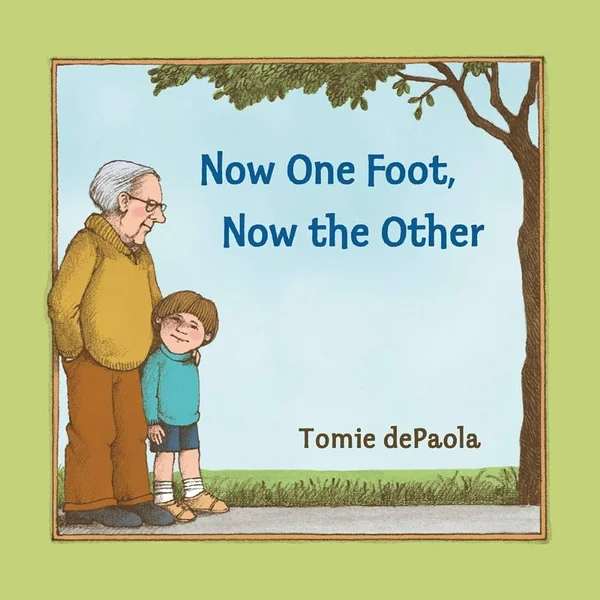
Cover of Now One Foot, Now the Other
Now One Foot, Now the Other
📚
Compassion Pre-K & Kindergarten
By Tomie dePaola

Book Guide

Now One Foot, Now the Other

A story that explores compassion and opens a conversation with your child.

★★★★★ Loved by families
This book teaches: Compassion. seeing past difference to offer kindness.

Before, During & After Reading

Guiding Questions for Parents.

Definition: The ability to feel what others are feeling and the action of trying to help them with their troubles.  In short:  Feel what others feel. Summary: Grandfather Bob adores his grandson, Bobby. He teaches Bobby how to walk, tells him stories, helps him make block towers, and takes him on special outings.  One day Grandfather Bob has a stroke and is confined to a hospital. When the grandfather returns home, he can’t talk or move naturally. It’s scary for the grandson, but he decides to try to revive Bob’s memories of their time together, hoping that this will heal his beloved grandfather. Bobby’s efforts work! Eventually he helps his grandfather talk and walk again.   Lesson Objectives: 
  1. Students will be more invested in their relationships with grandparents and elders. 
  2. Teachers can guide students in a discussion about how to help a family member who is ill.  
  Guiding Questions: 
  1. How did Bobby get his name? 
  2. What did Bobby’s grandfather teach his grandson? 
  3. Share about what happened when Bob and Bobby made a tower out of blocks, especially when the tower was all finished except for one block.
  4. What kind of stories did Bobby like to hear from his grandfather? 
  5. What did Bobby and his grandfather do on Bobby’s birthday? 
  6. When Bobby came home one day, his grandfather wasn’t there. What happened? 
  7. The doctor said he didn’t think the grandfather would be able to talk or walk again. What did Bobby do to help his grandfather get his memories back, speak, and learn to walk?  
  8. If you never met your grandparents, ask your parents to tell you about them. If you did meet your grandparents, ask them questions about their lives.  
  9. Did you ever have a family member who got sick? How did that make you feel? 
  10. Share about any happy memories of being with your grandparents or other elderly relatives.  
🌿   Virtue Connection: Compassion means feeling what another feels and choosing to act.

Hands-On Practice

Activities for This Story.

Activity: This is a two-day activity, including a field trip. Students make cards and deliver them to senior citizens. Teachers coach students how to have a conversation with their senior “partners” by role playing. Students learn to ask questions about the senior’s life as a child. They practice sharing something about themselves. It’s a good idea to bring some treats to share or ask the senior center to prepare snacks. If possible, practice a song that students could sing before they visit with their senior friends.    Materials Needed: Paper and markers or crayons for making cards; arranging a trip to a senior center   Directions:  Day #1: Explain: “Today we are making cards to take to some of our seniors/grandparents who would like to meet you. What do you remember about the story of the boy who helped his grandfather recall the things they did together? [pause for responses]  Older people like to talk about their memories, just like in the story. When we visit the senior center, you and your buddy will go up to a senior and give that person your cards. Then you can ask them about their memories of childhood, with questions like, ‘when you were my age, what did you like to do for fun?’ Before we go, we will practice here so you feel confident about asking questions. We will also practice being good listeners.”  Role play with your students using the following prompts (and get some ideas from them as well): 
  • Did you ever have a pet when you were a child? 
  • What was your favorite food for breakfast? 
  • Did you have brothers and sisters? 
  • What was your best memory from when you were my age? 
  • Did you have a best friend? What was their name and what did you like to do together? 
Direct students to make their cards. Guide them to invest time and effort into creating beautiful artwork with lots of colors. Ask them to write a message if they can write, or at least, ask them to write their names. Provide a word wall with vocabulary that matches this activity. For those who finish quickly, encourage them to make more cards. Students can bring several cards to the field trip.    Day #2: Students bring their cards with them to the senior center. If they’ve prepared a song, guide them to perform it, and then instruct them to spread out and pick someone (in pairs if they’re nervous), give the cards, and sit down for a conversation. Make sure all seniors are visited and all students participate. Back at school, have a class discussion about the experience, using these questions: 
  • What was your favorite part of the visit? 
  • What did you and your senior friend talk about?  
  • How did you feel after spending time with your senior friend? 
  • Did your senior friend enjoy spending time with you? 
  Wrap it up: We prepared cards for our senior friends and visited them because sometimes they are lonely and in need of companionship. We went there to cheer them up and show them that we care. Doing this kind of service means that we have compassion for those who need extra love. And hopefully it made you happy, too, to make new friends and give them something special.

About the Story.

This guide is part of the Values & Virtues library, a free collection of 400+ book guides and activities organized around 12 core virtues for children from pre-K to 6th grade. Each guide includes Guiding Questions designed to open a real conversation with your child in 10 minutes or less.

Read-aloud video · Best with headphones
Find this book at your library or bookstore →

Explore more guides for Pre-K & Kindergarten.