Cover of Lubna and Pebble
Lubna and Pebble
📚
Compassion 1st & 2nd Grade
By Wendy Meddour

Book Guide

Lubna and Pebble

A story that explores compassion and opens a conversation with your child.

★★★★★ Loved by families
This book teaches: Compassion. seeing past difference to offer kindness.

Before, During & After Reading

Guiding Questions for Parents.

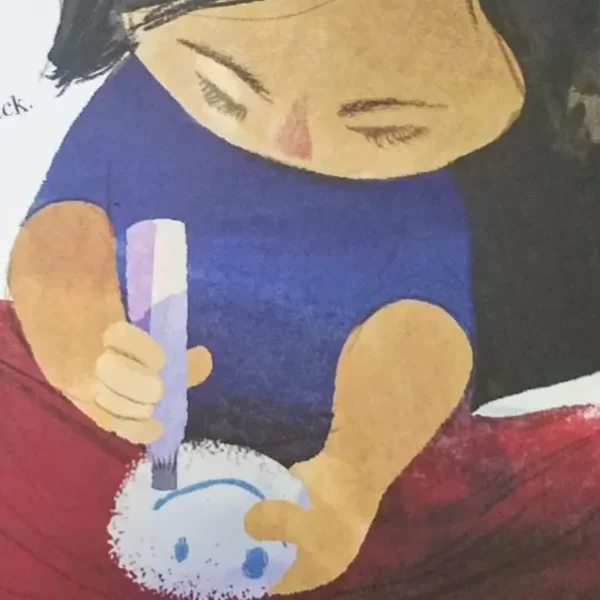
Definition: The ability to feel what others are feeling and the action of trying to help them with their troubles.  In short:  Feel what others feel. Summary: Lubna, a small child, and her dad arrive by boat at night and are transported to a “world of tents", a refugee camp. Lubna takes comfort in a pebble she found at the beach when they got off the boat. She brings it with her to the camp, and draws a face on it so it looks like a person. The pebble is her only companion until a boy, Amir, arrives at the camp. Lubna and Amir meet each other and she shows the frightened, unhappy boy her pebble. They spend time together until the day that Lubna and her dad prepare to leave the camp. Lubna makes a painful, but compassionate decision to give Amir her beloved pebble, and he gratefully accepts.    Lesson Objectives: 
  1. Teacher guides students in a discussion about what are refugees and what it’s like to live in a refugee camp (age appropriate, not scary)
  2. Students can be guided in a project to help local refugees. Lubna’s stone comforted her. Children refugees might be comforted by a stuffed animal or a nice blanket. 
  Guiding Questions: 
  1. Lubna and her dad were refugees who left their country because it was unsafe for them. What do you think life was like for them after they left? 
  2. What Lubna saw on her first morning after arriving by boat was a “world of tents.” What do you think she meant by that? 
  3. How did Lubna cheer herself up when she first arrived at the refugee camp?
  4. What did Lubna do to help Amir when he first arrived at the camp? 
  5. Why did Lubna give Amir her most prized possession? 
  6. Why did Lubna feel both happy and sad when it came time to leave the camp? 
  7. The word compassion means you can feel another’s feelings. Do you think Lubna could feel Amir’s feelings? Why or why not? 
  8. Do you think it’s hard to help someone else when you’re feeling sad? Why or why not? 
  9. Lubna was comforted by the pebble, even calling it a friend. Do you have something that helps you when you feel sad? 
  10. Can you think of a time when someone was sad and you helped them? What did you do?
🌿   Virtue Connection: Compassion means feeling what another feels and choosing to act.

Hands-On Practice

Activities for This Story.

Activity: The purpose of this activity is to teach children to be aware of the needs of others who are in difficult situations and to take some action to relieve their suffering. The teacher identifies a social service that this age group of children could perform. Some possibilities are: (1) collecting canned foods for the local food bank; (2) collecting money for UNICEF during Halloween -  if there is a program in your community, ask a representative to talk to your students about this organization and what it does to help children; (3) sponsoring a toy drive for underprivileged children - collect toys to give to a deserving organization in your community.   Materials needed: It depends on the social service organization the students will support. For example, if it’s collecting canned foods for the local food bank, a large collection container is needed in a visible place at the school. Make arrangements with the food bank for delivery of the cans. Ask a representative to come and talk to the students about the work they do and the population they serve. Make a chart with a T diagram, one section labeled “needs” and the other labeled “wants”. Prepare a letter explaining the project to send home.    Directions: If you choose to do a food bank project, explain the project and why it’s important. Tell  students that they will bring a letter home so that family members and neighbors know how to support the project. Explain that over the next couple of weeks, students bring food to school and put it in the container.    Initiate a discussion about needs and wants, with directions about what kinds of food products are accepted and why. Here are some questions for the needs and wants discussion: Teacher: “We will be filling out this chart about needs and wants. ‘Needs’ are what everyone needs in order to live. ‘Wants’ are what we’d like to have but can live without. Let me ask you some questions about this to see if you understand the difference.”
  1. Share about what you and everyone need in order to be healthy and experience well-being.  Answer: nutritious food, a safe place to live that is protected from bad weather and anything will harm you, clothing, clean water for drinking, bathing, and cooking, clean air inside and outside the home, access to health care, a supportive family/community, access to education
  2. Explain: “I wrote all these answers on the ‘Needs’ side of the T-diagram, so now let’s talk about each one and why it’s a need and not a want.” 
  3. Ask students to share about some things that belong on the “Want” side of our T-diagram. 
  4. Ask: “Do you ever see people where you live who don’t have the things they need? What do they need and what do you think we can do to help them?” 
  5. Ask: “How do you think people who don’t have their needs met feel?” 
  6. Ask: “Would it help them feel better if we were able to provide them with some help for their needs?”
  7. Discuss: “In the story, ‘Lubna and Pebble’ we learned about how refugee children feel when they have to leave their home in order to be safe. Is there anything you can think of that might make a refugee child feel better and is there any way we can help them?” 
  Wrap it up: Explain: “We’re collecting food for the needy and talking about needs and wants so that you can be more aware that there are people in our communities who have to worry every day about food, shelter and other needs. We feel compassion for them because they don’t always get the help they need and sometimes they are hungry, or don’t have a place to sleep, or are sick but aren’t able to pay for a doctor. As we understand more about their situation, we care more and want to help. It’s important to help out whenever we can. 

About the Story.

This guide is part of the Values & Virtues library, a free collection of 400+ book guides and activities organized around 12 core virtues for children from pre-K to 6th grade. Each guide includes Guiding Questions designed to open a real conversation with your child in 10 minutes or less.

Read-aloud video · Best with headphones
Find this book at your library or bookstore →

Explore more guides for 1st & 2nd Grade.