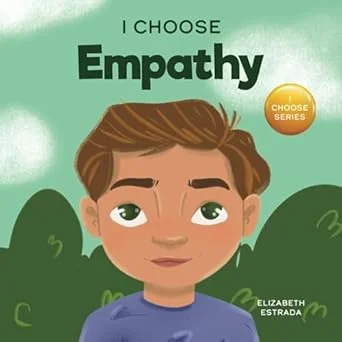
Cover of I Choose Empathy
I Choose Empathy
📚
Compassion Pre-K & Kindergarten

Book Guide

I Choose Empathy

A story that explores compassion and opens a conversation with your child.

★★★★★ Loved by families
This book teaches: Compassion. seeing past difference to offer kindness.

Before, During & After Reading

Guiding Questions for Parents.

Definition: The ability to feel what others are feeling and the action of trying to help them with their troubles.    In short:  Feel what others feel.

Summary: “Being empathetic is showing that you care, if that person needs you, you’ll always be right there.” This quote sums up the theme of this narrative poem. Students will enjoy the practical examples of what it means to have empathy.    Lesson Objectives: 
  1. Students are more inclined to show they care through their positive actions and words. 
  Guiding Questions: 
  1. Can you explain what the word “empathy” means? 
  2. What does a person look or sound like when they’re sad? 
  3. Do you think it would help a person who is sad if you listened to them or just sat with them? Why or why not? 
  4. When someone else is happy because they get a nice gift or win a race, can you be happy for them, or do you wish you had the gift and won the race? 
  5. What can you do for someone who is angry? 
  6. When someone notices you’re upset and they tell you they understand how you’re feeling, does it make you feel better, or not and why? 
  7. Imagine that a friend is scared of something; what could you do to help them? 
  8. What is something that causes you to feel scared? What could someone do to help you when you feel afraid? 
  9. When something is “contagious” it means that it spreads quickly. What do you think it means when the author says that empathy is contagious? 
  10. Do you like being around happy people? Would you rather be around a happy or a sad person? When someone is sad, do you feel like you could cheer them up? How? 
🌿   Virtue Connection: Compassion means feeling what another feels and choosing to act.

Hands-On Practice

Activities for This Story.


Activity: Students view the video. The teacher guides them in an empathy activity. The teacher reads a description of a typical emotional experience a student could have, and asks for a volunteer to act it out. The other students try to label the emotions the student might be experiencing in that situation, and they offer suggestions about what could be done to show they care. 
 

Materials needed: the video; a list for the teacher of situations that provoke different emotions (see below)
 

EMPATHY ACTIVITY When I call on you, stand up and show us what might happen in this situation - show us with your face, actions, and words. I’ll tell you the situation, and I’ll call on a volunteer to act it out: 

Situation #1: a new student is feeling shy and nervous on their first day of school (feeling nervous and afraid)


Situation #2:  a student falls down and has a bloody knee (feeling hurt and in pain)


Situation #3: a student is being teased by a bully (feeling angry and scared)


Situation #4: a student wins a race (feeling excited)


Situation #5: a student’s best friend is moving away (feeling sad)


Situation #6: a student is trying to write their name but it’s really hard (feeling frustrated)
 

Directions: Explain: “Can you tell how someone is feeling when you look at their face, notice how they are moving around, or hear what they are saying? Show me what a person’s face looks like when they are sad. Mad. Scared. Happy. Frustrated.  Today we’ll read a story about how to look for clues that tell you how another person is feeling. We’ll also talk about how to show you care about someone else. This story will help us understand how to have empathy, which means, how you show you care about others.” Show the resource video and invite students to circle time to discuss it. Tell students that they will be actors now, and you will call on them to act out different stories. Read situation #1. Ask for a volunteer. Tell the volunteer to stand up and show by actions, words, and facial expression how the person in the story is feeling. Ask students to describe the emotion (s) that go with the acting. Then ask if they can think of anything they could do or say to show the student they care. Go through all the scenarios and add new stories to act out. 
 

Wrap it up: Say: “When you can ‘read’ someone’s feelings in their words, actions, and facial expression, you are looking at clues about how to respond in a way that will help them. This helps us to be there for one another in good times and in more difficult times. Let’s try our best to show that we really care.” 
 

About the Story.

This guide is part of the Values & Virtues library, a free collection of 400+ book guides and activities organized around 12 core virtues for children from pre-K to 6th grade. Each guide includes Guiding Questions designed to open a real conversation with your child in 10 minutes or less.

Read-aloud video · Best with headphones
Find this book at your library or bookstore →

Explore more guides for Pre-K & Kindergarten.