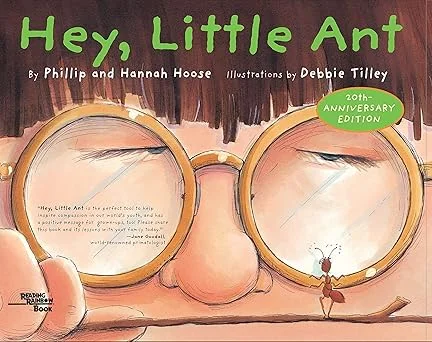
Cover of Hey, Little Ant
Hey, Little Ant
📚
Compassion 1st & 2nd Grade

Book Guide

Hey, Little Ant

A story that explores compassion and opens a conversation with your child.

★★★★★ Loved by families
This book teaches: Compassion. seeing past difference to offer kindness.

Before, During & After Reading

Guiding Questions for Parents.

  Definition: The ability to feel what others are feeling and the action of trying to help them with their troubles.   In short:  Feel what others feel. Summary: Should the boy squish the ant or let it be? This is the question at the beginning and end of this clever narrative poem.  What’s in the middle is a conversation between the ant, defending his freedom, and the boy, debating why he should or shouldn’t carry out his plan. The ant gives a reasonable defense, but does the boy consider the insect’s feelings or not?    Lesson Objectives: 
  1. The author encourages students to step in the ant’s “shoes” and consider its feelings, a life skill students need to practice. This story invites them to pause and take time to try to see from another’s point of view, instead of acting on impulse. 
  2. This story can lead into a science unit on insects. Ants are very interesting and fascinating, also easy to observe. See an ant activity under “Compassion Activities” on the website. 
  Guiding Questions: 
  1. What stops the boy from squishing the ant? 
  2. The ant says to the boy, “you are very much like me.” The boy doesn’t think so, but the ant explains why. How are the boy and ant alike? 
  3. The boy’s friends play a “squish the ant” game and they encourage him to squish the ant. Do you think these friends are giving good advice to the boy or not? Why?  
  4. Look at the picture of the small boy and big ant - does the big ant look scary to you? What if ants really were that big?!!
  5. The ant asks the boy to consider: “If you were me and I were you what would you want me to do?” How would you answer that? 
  6. At the very end of the story, how would you answer the question, “What do you think that kid should do?” 
  7. Ants are very interesting insects. Think of three questions to ask about ants and ask someone to help you find the answers. 
  8. Have you ever heard the phrase “stand in someone else’s shoes”? It means, try to imagine you are that “someone else” and think about how you’d want to be treated. Share about how the ant helped the boy to think about that. 
  9. Do you think you can tell how another person is feeling? Can you figure out if they are sad, mad, worried, scared, lonely? What about them helps you figure that out? 
  10. Insects are busy just like we are. They have jobs to do that help nature and us. Can you name any helpful insects?  If not, ask someone who can. 
🌿   Virtue Connection: Compassion means feeling what another feels and choosing to act.

Hands-On Practice

Activities for This Story.

Activity: Optional:  Students listen to “Hey, Little Ant” and discuss it. Then they watch the second video, “Ants” which is a study about the interesting life of ants, how they work together, and what their homes are like. If you don’t have access to either of these videos, share some information about ants from your own resources. Guide students to think about this: “now that you know more about how awesome ants are, would you hesitate to step on one?” Ideally, students get an opportunity to observe live ants, either outside or in an ant terrarium in the classroom. They take turns standing on a scale and record their weight. Then they calculate how much they could carry if they were an ant.  Ants carry anywhere from 10 - 50 times their weight! How much can a human carry?   

Materials needed: the videos (optional); a scale for weighing students; paper and pencil to record students’ weights; (optional): an ant farm/terrarium and/or a place outside to observe ants
 

Directions: (Optional) Explain that two videos about ants will be shown that will help students learn some interesting and fascinating facts about ants. Show both videos and discuss them, especially explore the question in the first video: should the boy step on the ant? After watching the second video, ask students what they learned about ants: “What impresses you about ants? [pause for responses] Did you realize how amazing ants are? One fact I want you to remember is that ants can carry 10 - 50 times their weight. Can humans do that? We will calculate your weight and how much you could lift if you were an ant. You will take turns weighing yourself and recording your weight. Then, you will sit down and multiply your weight times 10 and then times 50 to see how much  you could carry if you were an ant. I will demonstrate how to do the math.” Demonstrate how to multiply their weight by 10 and by 50. Help students who can’t do this yet, or have students help each other. Ask how much weight they think a human can carry - it will be less than their body weight for sure!  Invite students to discuss how amazing ants are, and ask them: “Now that you know more about ants, do you think you will leave them alone and just observe them, or step on them?” Make time to observe ants either outside or in the classroom if you have an ant farm.   

Wrap it up: Explain: “When we get to know the qualities of  another person, or an animal, we are more equipped to feel more respect for them. We are more likely to treat them with more kindness and compassion.” 
 

About the Story.

This guide is part of the Values & Virtues library, a free collection of 400+ book guides and activities organized around 12 core virtues for children from pre-K to 6th grade. Each guide includes Guiding Questions designed to open a real conversation with your child in 10 minutes or less.

Read-aloud video · Best with headphones
Find this book at your library or bookstore →

Explore more guides for 1st & 2nd Grade.