Cover of Chopsticks
Chopsticks
📚
Cooperation 3rd & 4th Grade

Book Guide

Chopsticks

A story that explores cooperation and opens a conversation with your child.

★★★★★ Loved by families
This book teaches: Cooperation. choosing the group over the self.

Before, During & After Reading

Guiding Questions for Parents.

Definition of Cooperation for children for 8 - 11 year olds: Cooperation happens when we work together with a good attitude to achieve the same goal or accomplish a common task. Sometimes it involves being willing to compromise or give something up so that the task can get done.    In a nutshell: Together we can do more Definition of Cooperation for children who are 8 or 9 years old: the process of working together with a good attitude to achieve the same goal or accomplish a common task. Sometimes it involves being willing to compromise or give something up so that the task can get done. Resource: TPAI adapted story: Chopsticks Summary: The story is about an activity designed by a teacher for her students. She leads them to a building with two rooms. In each room, diners are seated in a circle around a very large pot of noodles. In both rooms, those around the table are given very long chopsticks with which to eat, but in room #1, they can’t get food in their mouths because the chopsticks are too long. In room #2, diners are feeding each other across the circle, and no one goes hungry.  Lesson Objectives: 
  1. Students will look for new ways to work together with family members, classmates and teachers  to solve problems. Teachers can remind students of this phrase: “Let’s figure this out together” (or something similar)
  2. Students will be able to share about their own personal experiences with cooperation at home and at school, and in the community.
Guiding Questions: 
  1. Why do you think the teacher wanted to do this activity with her students?  
  2. Have you ever been around people who are angry and fighting? How did that make you feel? 
  3. How do you feel when you are around people who are nice to you and happy? 
  4. Why do you think the people in room #1 couldn’t solve their problem? And why do you think the people in room #2 were able to find a solution? 
  5. Can you think of a time when you figured out a solution to a problem with the help of another person? 
  6. How did you feel when you solved the problem together? 
  7. Can you think of a problem that needs solving? 
  8. Is there someone who could work with you to solve it? 
  9. The people in both rooms made choices about how to deal with their challenge and it affected the way they interacted with each other. Do you think the choices you make now about how you interact with others will make a difference in the future?  How? 
  10. Where do you see people helping one another and cooperating? Share some examples about what you see at school and in your community. 
🌿   Virtue Connection: Cooperation means choosing to contribute to something larger than yourself.

About the Story.

This guide is part of the Values & Virtues library, a free collection of 400+ book guides and activities organized around 12 core virtues for children from pre-K to 6th grade. Each guide includes Guiding Questions designed to open a real conversation with your child in 10 minutes or less.

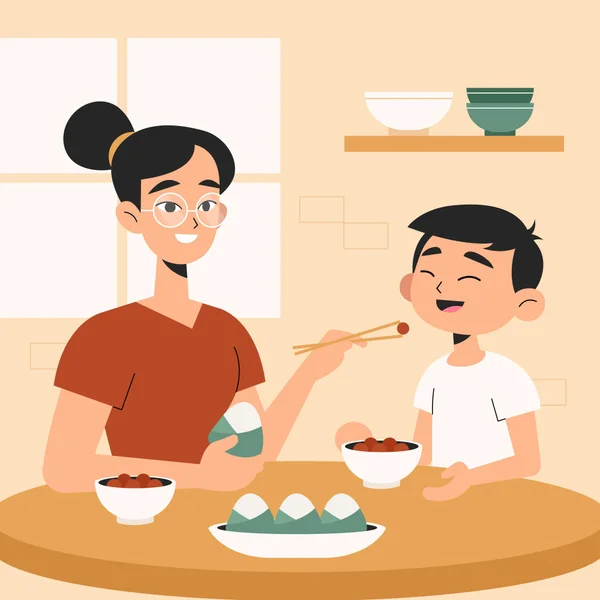
Story: A teacher decides to invite her class to participate in an activity.  She blindfolds her students and leads them into a building that has two rooms. They enter one room - people are arguing, shouting, even screaming, but they don’t know why because they can’t see.  The strange thing is that something smells really delicious making them very hungry - but they can’t wait to get away.  They leave and the teacher guides them to the other room. People in this room are chatting comfortably with one another - they seem very happy. Students hear slurping sounds and smell something delicious, just like in the other room. What’s going on? Any guesses?  No one figures out what’s going on, so the teacher has them take off their blindfolds and they enter room #1. It’s a dining room with a circular table that surrounds a very large pot with delicious, warm noodles. People are seated around the table complaining and arguing, trying to eat with very long chopsticks as utensils. Unfortunately, the chopsticks are really long and the diners can’t reach their mouths. They end up hitting one another as they try to maneuver these utensils. They’re really hungry but can’t eat this delicious food no matter how hard they try to get it in their mouths.  If you had a 3 foot long chopstick could you reach your mouth?  The students can’t wait to get away from that disaster, so they quickly exit and move on to room #2 which also is a dining room with a circular table that surrounds a very large pot with delicious, warm noodles. Here everyone is content and fully satisfied as they reach with their long chopsticks and feed each other across the table! These people had found a solution to the problem through cooperation and serving one another.  Back in class, the students discuss their observations. Everyone raises their hand when the teacher asks them if they’d prefer to be in room #2, even though it meant that they’d have to serve someone else. No one wanted to be in the group in room #1. “It’s obvious,” one student says, “When we’re just thinking about ourselves, like those in room #1, we miss out on opportunities.”  The students were able to see first hand that when people are willing to give and share like those in room #2,  it works out better for everyone.
Explore more guides for 3rd & 4th Grade.