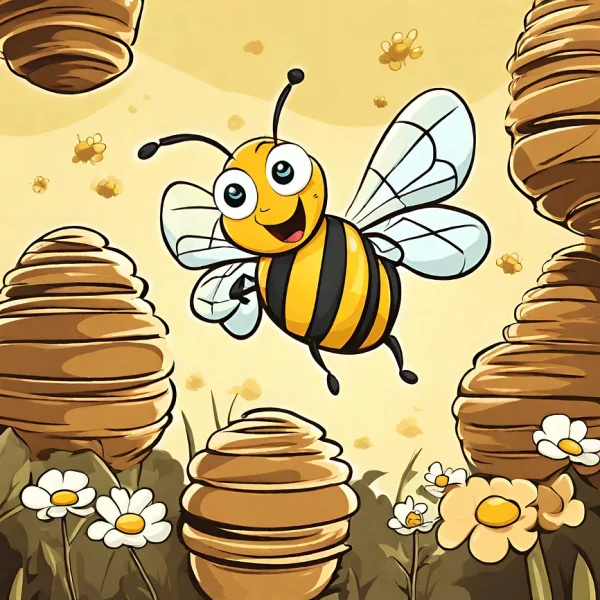
Cover of Bee Cooperative
Bee Cooperative
📚
Cooperation 1st & 2nd Grade

Book Guide

Bee Cooperative

A story that explores cooperation and opens a conversation with your child.

★★★★★ Loved by families
This book teaches: Cooperation. choosing the group over the self.

Before, During & After Reading

Guiding Questions for Parents.

Definition of Cooperation for 4 - 7 year olds: Cooperation happens when two or more people help each other to make something good happen. It can also apply to animals or parts of a whole that need each other and work together.  An example of this is the human body – all the parts work together to make you healthy. In a nutshell: Together we can do more.  Summary: Bees have a very interdependent lifestyle. In order to survive, these insects cooperate with one another, like many species in the natural world. This story is about a child who magically turns into a bee. As he buzzes around exploring the hive, he discovers the fascinating cooperative lifestyle within the bee colony. When he sees how bees support and protect the hive and one another, he’s able to understand and appreciate different examples of cooperation within the human world.  Lesson Objectives: 
  1. Students demonstrate more awareness of the cooperation in nature as they learn about bee colonies; they are able to identify examples of cooperation in nature and in human families and communities. 
Guiding questions: 
  1. Have you ever imagined you weren’t human like the person in this story? If so, what did you become and what did you do? 
  2. What do you think the saying “busy as a bee” means? Have you ever seen bees collecting nectar and pollen? 
  3. What are some of the jobs the worker bees do to take care of the hive?
  4. What does the Queen bee do for the hive, and how do the other bees take care of her? 
  5. How do the guard bees protect the hive? 
  6. What do the bees learn in bee school? 
  7. How do bees communicate with one another? Do you communicate with other humans just by talking? What are some other ways you communicate?  
  8. Can you think of some other ways humans take care of each other and cooperate that weren’t mentioned by the writer? 
  9. Can you think of something you do or would like to do that helps others? 
  10.  Do you know of other animals that work together to take care of each other’s needs? If so, tell us how they do that. 
 
🌿   Virtue Connection: Cooperation means choosing to contribute to something larger than yourself.

Hands-On Practice

Activities for This Story.


Note to Teachers: You can use this story from the curriculum to guide students in different bee activities described below in the directions. This activity is a science/character education combination and it’s a four-day lesson (20 minutes each day)


Activity:

Students create materials and act out the bee dramas in this story. 


Materials:

(1) access to a playground (ideally)

(2) sidewalk chalk to draw flowers on the pavement

(3) straws

(4) a sweet beverage and small cups (one per child)

(5) a paper queen bee

(6) teacher prep in advance, make a large figure 8 with chalk that the children could follow for the bee dance


Directions: 

This is a four-day activity plan, 20 minutes each day.


Day 1: Before the activity, Locate a large space and draw two horizontal lines, 20 feet or so apart, and a large figure 8 nearby. Take students to the playground or a big area where movement is possible. Announce: “Today we’re all going to bee school to practice flying backwards and flying in a figure eight. First I’ll turn you into bees, and then I will read the part in the story that explains why bees go to bee school.” Read the part of the story where children turn into bees while students stand next to each other on the line. Children act out turning into bees. Explain that bees need to learn how to locate the hive by flying backwards from it a short distance. They are told that on the count of 1-2-3 they will practice flying backwards from the line they’re standing on to another line 20 feet or so away and stop. The next action is the Figure 8 dance. Explain that today they will practice the “I found it” dance - when a bee finds flowers it does a figure 8 dance that shows where the flowers are. Students, one at a time, are instructed to “fly” the figure 8 drawn by the teacher 3 times and return to the line. Students can free fly for 5 minutes before ending the activity. 


Day 2:  

  • Prep: On the playground, draw a large hive (big enough for 2-3 children) with a door. Make a big paper queen and put her inside. Create a nectar table with prepared cups of a sweet liquid and a straw for each cup. 

  • Gather the class outside and create groups of 3-4 students. Explain that they will all be worker bees supporting the hive but first they need to draw flowers on the playground (5  minutes) Assign each group an area for this and give each group a name (it could be a type of flower that bees like) or number.  

  • Regroup and explain that they are now worker bees and will go out into the field of flowers and pretend to gather nectar. Explain: “Your tongue will now turn into a tube so you can suck nectar out of flowers. Your extra stomach will store the nectar until you get back to your hive where other bees help make honey and store it in hexagon shaped cells.”  Give each student a straw and tell them that they will be going to the nectar table, one group at a time, to collect their nectar, and return to the flower they created. 

  • One by one, each group is called to go to the nectar table, collect a cup of nectar (one per student) and sit down in their flower bed and drink the nectar. Then one by one, each group is called to go to the hive where they will deposit their empty cups in a basket in the hive, then return to their flower. 

  • Regroup and conclude the activity with a group discussion, asking them what it was like to pretend to be a worker bee. 


Day 3: Guard bees: 

  • Explain that today we will pretend we are guard bees protecting the hive with our super smelling senses. We will also get to be predators who want to attack the hive. 

  • Prep: prepare cotton balls with 2 very different scents, like Scent #1: peppermint and Scent #2: lemon.

  • Let each student smell both scents and identify them as either worker bee or predator scents.   

  • Arrange students in pairs - one student is in Group A and the other in Group B. The pairs face each other.  On one line is Group A, the guard bees. Facing them is Group B, the predators. Give each Group A member a scented cotton ball, Scent #1, that identifies them as part of the hive. Give each Group B member Scent #2 that identifies them as predators,  skunks and bears (students can choose what they want to be as long as it’s a natural predator of bees). Explain that the job of the Guard bee is to compare the scent of the predator with their own scent by smelling the scent of their partner, a predator. Give a signal for partners to meet up and tell the Guard bees to smell the cotton ball of the predator - is it the same or different than the one you have? Once Guard bees have correctly identified that the scents don’t match, they escort the predators away from the hive (to their seats). 

  • The groups switch so that everyone has a turn to be a guard bee and a predator. 

  • Bring all students together and talk about what they learned from these exercises about how bees cooperate with each other using these guiding questions: 

 
  1. What do you think the saying “busy as a bee” means?

  2. What are some of the jobs the worker bees do to take care of the hive?

  3. What does the Queen bee do for the hive, and how do the other bees take care of her? 

  4. How do the guard bees protect the hive? 

  5. What do the bees learn in bee school? 

  6. How do bees communicate with one another? 

  7. Name three ways that you communicate (speaking, writing, hand gestures, drawing, actions).

  8.  Do you know of other animals that work together to take care of each other’s needs? If so, tell us how they do that. 

Wrap it up: Explain: We have been studying how bees cooperate as members of a hive. They need each other in order to survive. Humans are similar because we also need each other in order to survive. If we didn’t cooperate with one another, life would be very, very difficult, even impossible! Note to teacher: this lesson is a great lead-in to other topics such as how members of a family, community and world help each other. 


Day 4: Optional: If possible, have a beekeeper bring a real hive into the classroom! 

About the Story.

This guide is part of the Values & Virtues library, a free collection of 400+ book guides and activities organized around 12 core virtues for children from pre-K to 6th grade. Each guide includes Guiding Questions designed to open a real conversation with your child in 10 minutes or less.

What if you had magic powers and could shrink, grow wings, have six legs instead of two, three eyes instead of two, antennae instead of ears, become fuzzy all over, collect nectar from flowers, and make something very sweet that bears and humans love to eat? What did you turn into? Yes, you are now a bee and your new home is a hive! Let’s imagine that this really did happen, and you wrote about it in your journal after you turned back into a human.


Here’s what your story might say:

I am now officially a bee. I have two pairs of wings and six legs, so I belong to the insect world. I’m very busy supporting my bee family of about 70,000 members. I turned into a worker bee, and my job is to gather nectar and pollen from the fields. Hail to the queen bee in our hive who’s busy laying between 1,200 - 2,000 eggs a day! She’s bigger than all the other bees, and is our fearless leader. I have these cool little pouches on the back of my legs in which I put the pollen I collect. My tongue is like a tube and it comes in handy as I suck nectar out of flowers. I also have an extra stomach for storing and transporting nectar to my hive where other bees help make honey and store it in hexagon shaped cells. 


One of my favorite jobs is when I get to be a nurse bee and take care of the Queen’s hatched eggs, which are white worm-like larvae in the shape of peanuts. Sometimes I feed Her Royal Highness a special food called royal jelly that only she gets to eat.


Before going out to the field to collect nectar I have to go to bee school. A bunch of us worker bees hang around outside the hive, facing it, and flying backwards to see what it looks like from a few feet away so we could remember how to get back home after collecting nectar. After graduating from bee school, we begin scouting for flowers. 


When I find lots of sumptuous flowers, I fly back to the hive to share the fragrances of the field with other foragers (those who gather food). To convince my family of bees, I do a bee dance by making a figure eight that lets them know where the flowers are in relation to the sun. I wiggle and wiggle until they start to follow me. 


We keep safe and protected in the hive thanks to the guard bees. We do have enemies, like skunks and bears.  The guard bees are the strongest among us and they examine all those who seek to enter our home, reaching out with their antennae to smell-check. Predators (enemies) are chased away and stung. Maybe you’ve been stung by a bee? I’m sure it hurt but that bee was just protecting itself. 


Journal Reflections after turning back into a human:  Living among the bees has taught me a lot about cooperation. None of us humans could survive on our own. It made me realize how lucky I am to be a part of a family at home, and a class with a teacher at school. I’m also a part of a community where there are people who keep me safe, like the police and fire departments. Doctors take care of my health. Farmers produce food that grocery stores sell to my family. Gas stations provide gas so we can travel. Because we depend so much on each other we’re really not that different from bees!  
Explore more guides for 1st & 2nd Grade.