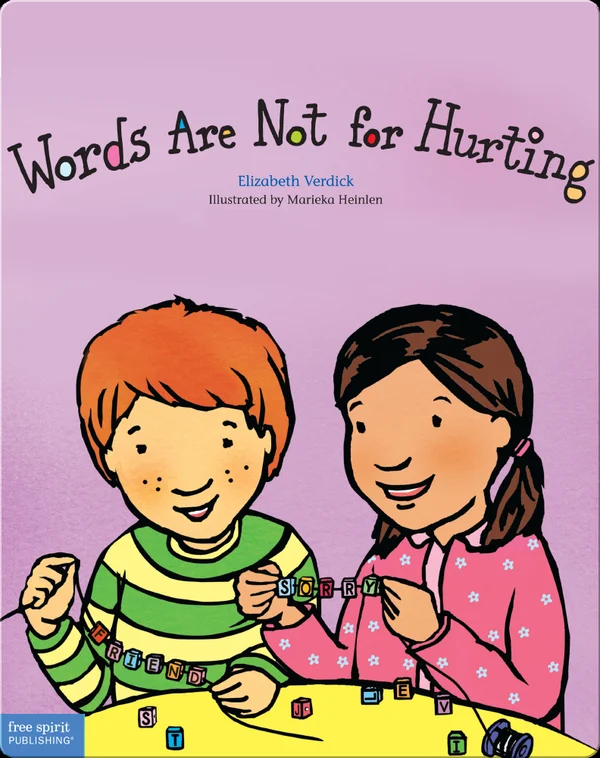
Cover of Words Are Not for Hurting
Words Are Not for Hurting
📚
Respect Pre-K & Kindergarten
By Elizabeth Verdick

Book Guide

Words Are Not for Hurting

A story that explores respect and opens a conversation with your child.

★★★★★ Loved by families
This book teaches: Respect. seeing the worth in every person.

Before, During & After Reading

Guiding Questions for Parents.

Definition: Showing respect means to use words and actions that show we care about all people and things.    In short: Value others, honor differences. Summary: Only 26 letters make millions of words, all kinds of words! This book gives examples of hurtful words and helpful words, how it makes us feel when we say or hear them. It also explains what we can do about hurtful words, when we’ve said something we regret, or when we’ve heard something that hurt us.  We can remind ourselves daily of the main message in this story: “Your words can hurt or your words can help.”   Lesson Objectives: 
  1. Students demonstrate more awareness and kindness in choosing their words. They are more confident about saying sorry or asking for help when it’s needed. 
  2. This book has a lot of good information in it that teachers can reinforce through lots of discussion all through the year. 
  Guiding Questions: 
  1. How many letters are in the English alphabet? How many words can be made from this alphabet? 
  2. What are some examples of short words? Long words? Silly words? 
  3. What are some of the important words you can use to show kindness? 
  4. Do you have some funny words that make you laugh? What are they? 
  5. Do you have a song you’ve memorized? Can you sing it for someone? 
  6. Who do your words belong to? 
  7. Your words can … or your words can … (Fill in the blank)
  8. How do you feel when you hear helpful words? 
  9. How do you feel when you hear hurtful words? 
  10. What can you say when you’ve said hurtful words? What can you do when someone says hurtful words? 
🌿   Virtue Connection: Respect means seeing the worth in every person.

Hands-On Practice

Activities for This Story.

Activity: Students make faces on five different cut out circles. The teacher models how to make each one (keep it simple) - sad, mad, scared, left out, mixed up - or the teacher can provide kids with premade faces and let them decorate with colors. Prepare sticks with glued-on circles ahead of class or have the students do the gluing. When the props are ready, ask students to bring their sticks to circle time. Explain that you will read some words that a person says from the book. Tell them to imagine they are the one to whom the person is speaking. Ask them to hold up the stick that shows how those words would make them feel.    Materials needed: decorating materials (crayons, etc.), popsicle sticks, Elmer’s glue, premade faces or blank circles at least 5 inches circumference   Directions:  Day #1: Give directions on making or decorating the faces. One at a time, introduce each emotion, talk about it, ask them to express the emotion on their own faces, and look at each other. Tell them to draw the emotion on the circle.  Draw a model for each emotion if you think they need it: sad, mad, scared, left out, mixed up (or make your own list of emotions).    Day #2: Tell students to bring their “faces” to circle time. Review each emotion on the faces. Begin the activity:   
  • Teacher: “Who do your words belong to?” Students respond: “My words belong to me.” (repeat a few times, like a chant or in a singing voice to make it more fun) Then ask, what do you think that means? 
  • Ask students to fill in the blanks:  Your words can … (hurt) or your words can … (help). Again, have some fun with this and make it into a chant or song. 
  • Repeat the sentence examples on pages 10 and 11 (helpful words) and 12 and 13 (hurtful words). After each sentence, ask children to raise the face that goes with the picture. Students can also express the emotion on their own faces. 
  • Continue the exercise by making up scenarios that fit each emotion face - ask students to raise the correct face
  Guide a discussion with the following questions as students raise hands with responses:   
  1. How do you feel when you hear helpful words? 
  2. How do you feel when you hear hurtful words? 
  3. What can you say when you’ve said hurtful words? 
  4. What can you do when someone says hurtful words? 
  5. What are some of the important words you can use to show kindness? 
  Wrap it up: Remind students that their emotions, and everyone’s emotions, are very, very important. Now we know some helpful words we can say, and some hurtful words we don’t want to say. 

About the Story.

This guide is part of the Values & Virtues library, a free collection of 400+ book guides and activities organized around 12 core virtues for children from pre-K to 6th grade. Each guide includes Guiding Questions designed to open a real conversation with your child in 10 minutes or less.

Read-aloud video · Best with headphones
Find this book at your library or bookstore →

Explore more guides for Pre-K & Kindergarten.