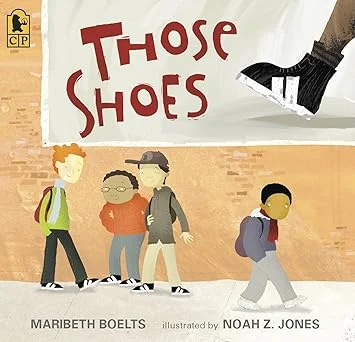
Cover of Those Shoes
Those Shoes
📚
Gratitude 1st & 2nd Grade

Book Guide

Those Shoes

A story that explores gratitude and opens a conversation with your child.

★★★★★ Loved by families
This book teaches: Gratitude. noticing and appreciating what is already good.

Before, During & After Reading

Guiding Questions for Parents.

Definition: Someone who is grateful is thankful for people, nature, and things. Stewardship means taking good care of what we’ve been given. In short: Thankful for every blessing, big or small.  Summary: Jeremy tells his grandma he wants some fancy shoes that will help him run fast, but she tells him he needs boots, not shoes, because it’s going to get cold. Finally, grandma takes him to buy the shoes he wants, but they’re too expensive. They go to the thrift shop and he finds the right shoes, but they’re too small. He buys them but they are uncomfortable and useless. Finally Jeremy realizes that his new friend Antonio’s feet are just the right size for the thrift store shoes. Life gets better for Jeremy when he decides to give the shoes to Antonio. The first snowfall arrives, Jeremy doesn’t have to wear the hand-me-down shoes anymore. Instead he wears his brand new boots, perfect for the weather!    Lesson Objectives: 
  1. Students grow their generosity, are more willing to share what they have with others (Jeremy gave his shoes to Antonio).
  2. Students talk about the difference between “needs” and “wants.” Teacher note: Everyone needs food, shelter, clothing, education, a family/community, health care, and safety. “Wants” are things  that we desire, but can live without. 
  Guiding Questions: 
  1. Jeremy wanted special shoes, but new ones were too expensive so his grandmother took him to a thrift store. Describe what a thrift store is, and why it could be a good place to look for clothes and all kinds of things. If you don’t know what a thrift store is, ask someone. 
  2.  Does everyone need shoes? Does everyone need expensive, brand new shoes? 
  3. Why did Jeremy buy the high top shoes even though they didn’t fit? 
  4. Why do you think Jeremy kept saying while playing with Antonio, “I’m not going to do it?”
  5. What does Jeremy do with the too-small shoes? 
  6. Why was Jeremy excited when it snowed while he was at school? 
  7. Do you think it was hard or easy for Jeremy to do what he did for Antonio? 
  8. What do you think the difference is between needing something and wanting something? Here’s a hint. We need food, shelter, clothing, fresh air, water, a family (and a few more things). We may want fancy, expensive shoes, the best bike you can buy, or more than one dessert for dinner, but we don’t need those things in order to live. 
  9. Perhaps Jeremy could have found a way to raise money for the shoes he wanted by asking neighbors if they needed help with anything. Have you ever tried to earn money by doing something for others? If so, what did you do and how did you spend the money? 
  10. Antonio was very grateful to Jeremy. Have you ever given something special to someone, or received something you really needed from someone? Tell what happened.  
 
🌿   Virtue Connection: Gratitude means noticing and appreciating what is already good.

Hands-On Practice

Activities for This Story.

Activity Gratitude, Levels 1, 2  

Resource: Those Shoes  

Activity: Students talk about the difference between “needs” and “wants.” The teacher makes teams of 2 or 3 students and each team creates a chart that’s divided into 2 sections, “Needs” and “Wants”. Students can provide their own illustrations for each section or they can cut pictures out of magazines and use those.   

Materials needed:  poster boards; art materials; markers; magazines   

Directions: Ask: “What do you think the difference is between needing something and wanting something? [wait for responses] Explain: “We

need food, shelter, clothing, fresh air, clean water, a family, health care, education, and safety. We may

want fancy, expensive shoes, the best bike you can buy, or more than one dessert for dinner, but we don’t need those things in order to live.” After discussing this topic, create small teams of 2 or 3 students. Show them the materials for poster making. Guide them to divide the poster in half, label each section, and illustrate using drawings or magazine cut-outs. Conduct a show and tell when they’re finished.   

Wrap it up: Explain: “It’s important to know the difference between needs and wants. Some children in our world don’t even get their needs met and because of that they may be unhealthy, scared, and unhappy. Because we have our needs met, we can be grateful for that. We can also desire or want more, and if we do, we can talk it over with someone in our family, or a teacher or coach who can help us work towards making those dreams come true. We can also find ways to help those whose needs are not being met. There are many good organizations that give us opportunities to help. If you know of any, please tell me. If not, I’ll share some ideas with you. We’ll plan a project in which we can help those who need our help.”    

About the Story.

This guide is part of the Values & Virtues library, a free collection of 400+ book guides and activities organized around 12 core virtues for children from pre-K to 6th grade. Each guide includes Guiding Questions designed to open a real conversation with your child in 10 minutes or less.

Read-aloud video · Best with headphones
Find this book at your library or bookstore →

Explore more guides for 1st & 2nd Grade.