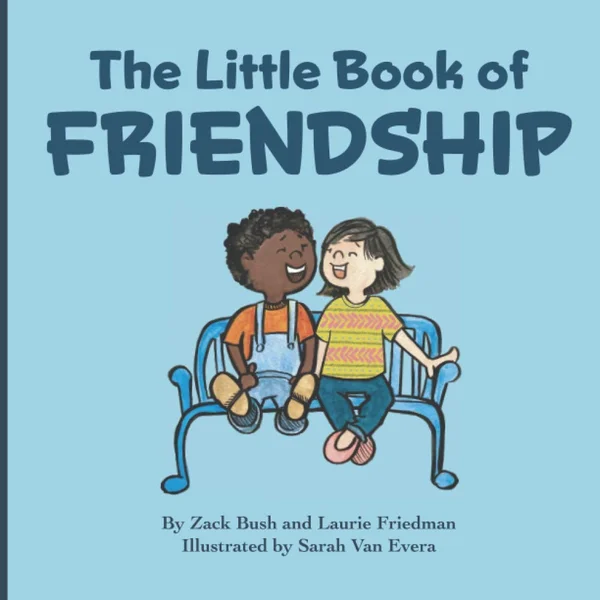
Cover of The Little Book Of Friendship
The Little Book Of Friendship
📚
Friendship 1st & 2nd Grade
By Laurie Friedman

Book Guide

The Little Book Of Friendship

A story that explores friendship and opens a conversation with your child.

★★★★★ Loved by families
This book teaches: Friendship. showing up for someone else.

Before, During & After Reading

Guiding Questions for Parents.

Definition: A friend is someone you like spending time with because they make you feel happy and special, and help you when you need it.  In short: Build bonds that last forever. Summary: Most young children need tips on how to make and keep friends. Growing flowers is like growing friendships, we start by “planting seeds”, like introducing ourselves, using good words to encourage others, and doing nice things for each other. How do we become good friends? We invest in friendship by doing things together, cheering each other up, apologizing when a mistake is made, and working together to resolve conflicts. This book has simple and practical ideas to help kids navigate the sometimes tricky but very important challenge of making and keeping friends.    Lesson Objectives: 
  1. Armed with practical ideas on how to make and keep friends, students will feel more confident to go beyond their hesitations and use problem solving strategies when it comes to relationship challenges. 
  2. Teachers can guide students in discussions about the relationship strategies presented in this book. Teachers can form small groups and meet with them frequently to discuss how it’s going in their relationships with one another, and with other kids at school. 
  Guiding Questions: 
  1. Explain how starting a new friendship is like planting seeds, using examples from the story. 
  2. Do you introduce yourself to someone new, or do you wait for them to introduce themselves? 
  3. “The best way to make a friend is to be a friend.” Explain what this means to you. 
  4. What are three different ways to use words to make friends? 
  5. What are three different ways to do nice things for others? 
  6. What are three different ways to be a good friend? 
  7. Do you ever have disagreements with your friends? 
  8. How do you solve conflicts with friends or family members? 
  9. If you don’t have a good friend, what could you do to make that happen? Who could help you do that? 
  10. Do you have someone who cheers you up when you’re feeling sad? If so, how do they do that? Do you cheer anyone up? What do you do? 
🌿   Virtue Connection: Friendship means showing up for someone else, consistently.

Hands-On Practice

Activities for This Story.

Activity: Students listen to the resource video (optional). They learn words that describe positive attributes of others. It is explained that we can build friendships when we use these words to show that we appreciate others. A list of character attributes is presented along with a brief definition for each one. Students are guided to discover that being able to recognize good qualities in others is an important step in making friends. They participate in a game, the Friendship Yarn Circle game.

Materials needed: a list of attributes on a word wall, including: honest, kind, determined, courageous, caring, artistic, musical, athletic, respectful, friendly, helpful, fair, understanding, funny, etc.; a ball of yarn

Directions:  Explain that today’s activity is about making and keeping friends. Show the resource video, and guide a brief discussion about it (optional). Tell students that one way to make and keep friends is to use special words that show what you appreciate about another person. Go over the list of positive attributes, giving definitions and examples. Explain the Friendship Yarn Circle game. Students sit in a circle. One student holds a ball of yarn. They call out the name of a classmate and a word from the attributes list that describes that person. Sample: “Sam, I appreciate you because you are funny.” Then they throw the ball of yarn to that person. The receiver chooses another student and attribute (it can be the same or different), and this goes on until all students have received the ball of yarn and an appreciation. 

Wrap it up: Explain that the purpose of this activity is to practice giving an appreciation to someone else by naming a quality they have that you admire. “Try to use this word wall of attributes when you talk to your classmates. Let them know that you appreciate their talents and admire their good qualities. I will leave the word wall display to remind you to use these words to build friendships with your classmates.”  

About the Story.

This guide is part of the Values & Virtues library, a free collection of 400+ book guides and activities organized around 12 core virtues for children from pre-K to 6th grade. Each guide includes Guiding Questions designed to open a real conversation with your child in 10 minutes or less.

Read-aloud video · Best with headphones
Find this book at your library or bookstore →

Explore more guides for 1st & 2nd Grade.