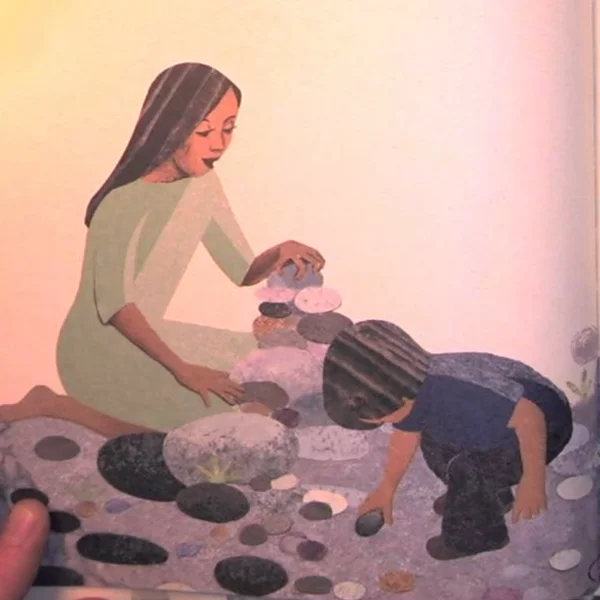
Cover of The Forgiveness Garden
The Forgiveness Garden
📚
Patience 5th & 6th Grade
By Lauren Thompson

Book Guide

The Forgiveness Garden

A story that explores patience and opens a conversation with your child.

★★★★★ Loved by families
This book teaches: Patience. staying calm while something unfolds.

Before, During & After Reading

Guiding Questions for Parents.

Definition: Patience means having self-control, waiting and enduring when one would rather not.  In short: Stay calm while you wait. Summary: Two villages across the river from one another suffer from a seemingly endless history of mutual hatred. One day, a girl named Sama is struck by a rock thrown by a boy on the other side of the river. Sama’s anger and desire for revenge ends when she sees her own dark brooding reflection in the river. When her people insist that she throw a stone at Karune, the boy who had wounded her, she refuses and persuades some of the villagers to join her in building a forgiveness flower garden along the river. Karune joins her after much thought, and they sit together in the garden and begin the process of healing. This story is fictional but the Garden of Forgiveness is a real place and exists in Beirut, Lebanon. There’s an author’s note at the end of the book that explains the historical background of this beautiful story.    Lesson Objectives: 
  1. Teachers can link this story to other subject areas, such as geography of the Middle East, and recent history of that area (simplified for 10 and 11 year olds)
  2. Students discuss how lack of self-control leads to negative consequences, whereas the desire to communicate respectfully with the goal of mutual respect is beneficial. They discuss how the story conveys this theme and how the message applies to their own lives. 
  Guiding Questions: 
  1. What sparked the stone-throwing fight between the two villages? 
  2. What happened to Sama during the fight and how did that make her feel? 
  3. Sama had an experience by the river when she saw her reflection. What happened? 
  4. Sama had a chance to get revenge against Karune. But she made a decision to not throw a stone at him. Instead she encouraged everyone to _________? (fill in the blank)  
  5. “If we forgive, must we forget all that has happened?” How would you answer this question? 
  6. “Must we apologize?” How would you answer this question? 
  7. When both villages worked on this project together, it was a win-win outcome. Why? 
  8. What brave action did Karune and Sama take at the end of the story and why was it difficult to do what they did? 
  9. Have you ever had a grudge against someone? Describe what happened. 
  10. The two villages had hated each other for many years. Do you think it’s a good thing to resolve conflict sooner rather than later? Why or why not? 
 
🌿   Virtue Connection: Patience means waiting without losing yourself.

Hands-On Practice

Activities for This Story.

Activity: Students are guided by the teacher to practice conflict resolution skills using I statements and apologies.      Materials needed: Index cards, enough for 3 cards/student; writing materials, 3 charts:  (1) “Conflict Resolution Guidelines” (2) “I-Messages” (from the “Activity” that goes with “Cooperation, Levels 5,6”) (3) “How to Apologize and Mean It” (from the “Activity” that goes with “Cooperation, Levels 5,6”)  

Chart: I-Messages I feel______when_________because_____________ (my needs).  

 Chart: Steps to Conflict Resolution: 


  • Step back and breathe - separate and take a breather to calm down


  • Get a mediator. If you have trained peer peace mediators, ask them to come help you discuss the issue. If not, ask a teacher if you think the conflict needs a third party. 


  • Mediation begins. Both sides need to listen fully to one another. Toss a coin to determine who goes first. When explaining your point of view use I statements - use the I statement chart for reference. No interrupting once a person starts sharing. Both sides get equal time. 


  • Brainstorm solutions. Discuss options that will be a win/win for both parties. 


  • Choose the best option. Make an agreement based on that. 


  • Follow up. Are we good? Check in. If there are still problems, repeat the process. 
 

Chart: How to Apologize and Mean It  I’m sorry for__________. It was wrong because ___________. I think you feel__________. Is there anything I can do to make it better?    Directions: This activity works best when it’s divided into two parts, Day #1 and Day #2.    Introduce the topic: “Self-control” on Day #1. Link it to the story of “The Forgiveness Garden” through a recap of the story details, emphasizing the conflict resolution process that took place between the enemies. Present the chart: “Steps to Conflict Resolution,” and check for comprehension, making sure students understand why each step is necessary. Review the “I-Messages” chart and the “How to Apologize and Mean It,” chart, explaining that students will be referring to all three charts as they do an activity the next day.    On Day #2, students are given 3x5 cards and directed to write 2-3 sentences about a typical conflict that occurs at school or at home. Give prompts if needed, such as, (1) you accidentally bump into another student, and the other student is very angry, thinking you did it on purpose, (2) someone calls you names and hurts your feelings, (3) another student refuses to let you sit next to them. It’s up to each student to contribute their idea anonymously or sign their name.  Collect the cards and read them to the class. After each reading, choose a pair to come up in front of the class to resolve the conflict using I-messages, apology guidelines (when needed), and conflict resolution steps.  Coach students as they present. Invite their classmates to make suggestions. Because conflict resolution is hard to learn, this lesson should be repeated many times throughout the school year.  Wrap it up: The teacher concludes the lesson with encouraging comments on the progress students are making in learning this very difficult process of resolving conflict. Students are told that they will practice these methods frequently during the school year.

About the Story.

This guide is part of the Values & Virtues library, a free collection of 400+ book guides and activities organized around 12 core virtues for children from pre-K to 6th grade. Each guide includes Guiding Questions designed to open a real conversation with your child in 10 minutes or less.

Read-aloud video · Best with headphones
Find this book at your library or bookstore →

Explore more guides for 5th & 6th Grade.