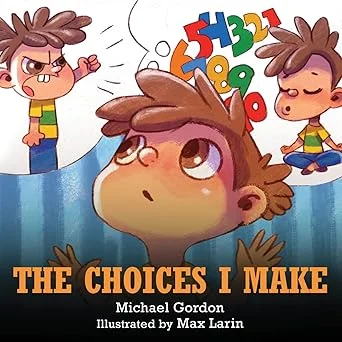
Cover of The Choices I make
The Choices I make
📚
Patience Pre-K & Kindergarten
By Michael Gordon

Book Guide

The Choices I make

A story that explores patience and opens a conversation with your child.

★★★★★ Loved by families
This book teaches: Patience. staying calm while something unfolds.

Before, During & After Reading

Guiding Questions for Parents.

Definition: Patience means having self-control, waiting and enduring when one would rather not. In short: Stay calm while you wait. Summary: When Josh mistakenly accuses his sister of stealing his toy, his dad gives him some good advice about self-control. He asks Josh to reflect on how shouting at his sister felt - did it make him feel better or worse? Josh realizes that he needs to think about his choices when he starts to get angry. He has a few opportunities to practice pausing before acting on angry impulses, and when he’s able to redirect his thoughts, it feels good. He’s learned that not acting on angry impulses is always the best choice!    Lesson Objectives: 
  1. Students demonstrate more ability to not act on angry impulses as they practice strategies like pausing and counting to 10 before doing or saying anything. 
  2. Teachers can guide students to act out different scenarios that show the different choices that can be made when a problem arises. They can introduce new strategies to use when anger arises. 
  Guiding Questions: 
  1. Why did Josh get upset when he got home from school?
  2. Did Emily steal Josh’s toy? 
  3. Josh’s dad asked him, “did shouting make you feel better or worse?” Did this question help Josh decide to try to practice self-control? 
  4. What did Josh decide to do the next time he has a choice about his behavior? 
  5. Why did Josh decide not to eat his sister’s birthday cake, even though he wanted to? 
  6. Why did Josh get mad at his friends and what did he do to pause and not react? 
  7. Why did Josh feel proud of himself when he was able to stop himself from reacting when his mom said he couldn’t have candy? 
  8. What kinds of things make you angry?
  9. What do you usually do when you get angry - do you fight back using angry words and/or your body (punching, kicking)? 
  10. Is there something you do to help you stop and think before acting and speaking when you get angry? Ask someone you trust for suggestions. 
🌿   Virtue Connection: Patience means waiting without losing yourself.

Hands-On Practice

Activities for This Story.

Activity: Review the story and ask students what Josh learned to do to keep himself from getting upset. After a brief discussion, explain the STP technique of managing emotions. Students create signs to use in the following STP exercise. Describe different scenarios in which emotional control is needed, and guide students how to use the STP technique.    Materials needed: Paper circles (about 4 inches circumference), popsicle sticks, glue, drawing and coloring materials. The teacher makes 3 models that students can copy - one circle says “STOP”, the second says “THINK” and has a light bulb on it, the third says “PLAN” and has a mouth. Each is attached to a popsicle stick.    Directions:  Session One: “Today we’re going to review the story ‘The Choices I Make’ and learn a way to help us make good choices when something upsetting happens.” The teacher reviews or rereads the story, and guides students to reflect on how Josh controlled his emotions. Then, “I will show you a handy way to remember what to do when something upsetting happens. It’s called the STP method. ‘S’ stands for ‘stop’,  ‘T’ stands for ‘think’, and ‘P’ stands for ‘plan’. In the story we just reviewed, Josh gets very upset when his sister plays with his favorite toy airplane. He yells at her and her feelings are hurt. Let’s imagine he uses the STP method instead of yelling. Here’s what that would look like: Josh (1) stops himself from yelling, (2) thinks about how to handle the situation, and (3) makes a plan to ask his sister for his toy. He gets his toy and no one feels bad. We will practice STP but first we need to make some signs to help us.” Show examples of each sign. STOP is written on one and is illustrated with a stop sign. THINK  is written on the second one and is  illustrated with a light bulb, and PLAN is written on the third one and it’s illustrated with a mouth.  Provide students with 3 circles. They copy the samples and glue the circles onto popsicle sticks.    Session 2: “Now we will practice using STP so we get really good at using it! I will tell some short stories and you will raise your signs when it’s the right time.” Tell stories that fit this exercise. The stories are told dramatically so that the narrator is on the verge of losing it - but stops when the students raise their STOP sign. Students are signaled to raise their signs at the appropriate times during the telling of the story.    Sample: “One day I was playing with my friend and he broke my favorite toy. I was so mad I wanted to punch him! [students raise the stop sign]. Then I thought about what to do. He is my best friend and I don’t want to lose him. [students raise the think sign] I know, I’ll tell him how I feel about it using an ‘I’ statement and give him a chance to apologize. [students raise the plan sign]. So that’s what I did, and he and I are still best friends.”    Wrap it up: Conclude the activity with a review of STOP. Set aside time the next week or once a week for several weeks, to practice this method. Ask students to share about when they used it.

About the Story.

This guide is part of the Values & Virtues library, a free collection of 400+ book guides and activities organized around 12 core virtues for children from pre-K to 6th grade. Each guide includes Guiding Questions designed to open a real conversation with your child in 10 minutes or less.

Read-aloud video · Best with headphones
Find this book at your library or bookstore →

Explore more guides for Pre-K & Kindergarten.