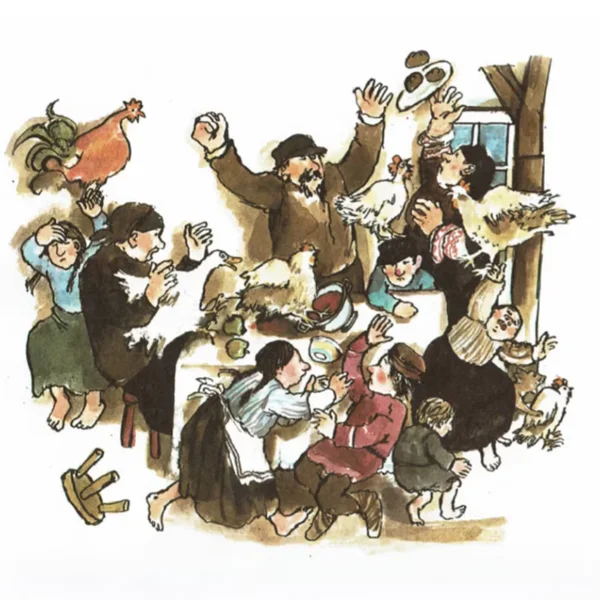
Cover of It Could Always be Worse
It Could Always be Worse
📚
Gratitude 1st & 2nd Grade
By Margot Zemach

Book Guide

It Could Always be Worse

A story that explores gratitude and opens a conversation with your child.

★★★★★ Loved by families
This book teaches: Gratitude. noticing and appreciating what is already good.

Before, During & After Reading

Guiding Questions for Parents.

Definition: Someone who is grateful is thankful for people, nature, and things. Stewardship means taking good care of what we’ve been given. In short: Thankful for every blessing, big or small. Summary: This is a humorous but instructive Yiddish folktale about gratitude. A poor family with six children lives in a crowded noisy hut. The husband is perplexed when he gets strange advice from the local rabbi. Because he trusts his rabbi, he does what he’s told and brings the farm’s chickens and roosters inside the hut, creating even more noise and chaos. The frustrated man continues to consult with the rabbi, who advises him to move all the animals from the yard into the small house. Eventually, the rabbi offers a solution that works and teaches the husband to appreciate his living situation.  Lesson Objectives: 
  1. Teacher guides students to make two lists: (a) what are my frustrations?  (b) what are my gratitudes? A discussion follows regarding how to decrease the list of frustrations and how to increase the list of gratitudes. 
  2. Students problem solve in pairs or teams, sharing helpful advice with one another.
Guiding Questions: 
  1. Why did the husband consult with the rabbi? 
  2. Were you surprised by the rabbi’s advice? Why? 
  3. Why did the rabbi feel peaceful at the end of the story, even though his living situation was the same as it was in the beginning of the story? 
  4. What do you think the author of this story wanted you to learn? 
  5. What does the title of the story mean to you? 
  6. The husband got frustrated in the beginning of the story and went to the rabbi for help. Is there someone you can go to for advice when you get frustrated? 
  7. Besides talking with someone about the problem, what else do you do when you get frustrated? 
  8. When you compare yourself with others, do you wish you could have what they have? What would help you feel better when that happens? 
  9. When you think about others who have less than you do, are you able to feel grateful for what you have? Why or why not?
  10. Think about a time when you felt grateful. Did you also feel happy? Think about a time when you were complaining. How did you feel then? 
   
🌿   Virtue Connection: Gratitude means noticing and appreciating what is already good.

About the Story.

This guide is part of the Values & Virtues library, a free collection of 400+ book guides and activities organized around 12 core virtues for children from pre-K to 6th grade. Each guide includes Guiding Questions designed to open a real conversation with your child in 10 minutes or less.

Read-aloud video · Best with headphones
Find this book at your library or bookstore →

Explore more guides for 1st & 2nd Grade.