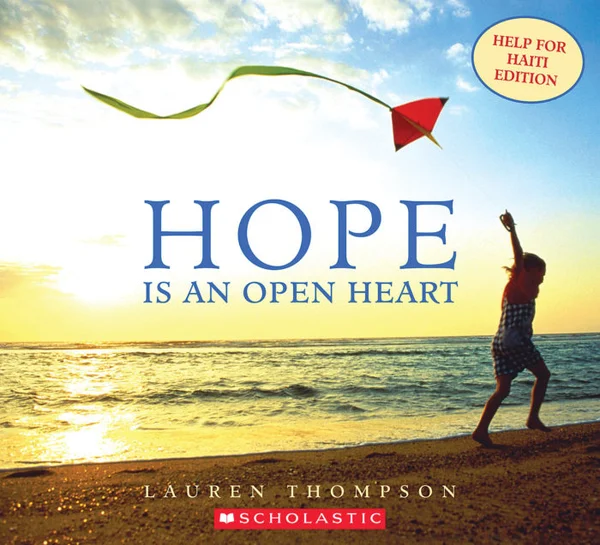
Cover of Hope is an Open Heart!
Hope is an Open Heart!
📚
Hope Pre-K & Kindergarten
By Lauren Thompson

Book Guide

Hope is an Open Heart!

A story that explores hope and opens a conversation with your child.

★★★★★ Loved by families
This book teaches: Hope. believing that things can get better.

Before, During & After Reading

Guiding Questions for Parents.

Definition: To be hopeful means to believe that something good can happen, even when it doesn’t look like it, or when it turns out differently than expected. In short: Believe that something good can happen. Summary: Children will enjoy the photographs that illustrate the beautiful words about hope that are found in this book. “Sometimes hope feels far away, but hope is always there.” Hope appears when we are able to feel our emotions of sadness, fear, or anger, and share them with those who love and understand us. We experience hope when we are cared for, when we can find happiness in simple things, when we are able to do things we didn’t think we couldn’t. “Hope is a heart that is open to the world around you.”  Lesson Objectives: 
  1. Students will be able to demonstrate comprehension of what it means to have hope as they share examples from their own lives that resemble the ones in this book. 
Guiding Questions: 
  1. Hope makes you feel happy. Does hope seem far away when you are sad or mad? 
  2. Does getting a hug from someone who loves you make you feel better when you don’t feel hopeful? Next time you feel upset, ask for a hug if that usually makes you feel better. 
  3. When you are scared or angry, does it help when you can talk about it with someone who understands you? 
  4. Who can you ask for help when you need it? 
  5. Do you think other kids feel lonely sometimes? If yes, how do you know and what one thing you could do to show you care? 
  6. “Hope is knowing that things change.” Share about a time when you had a hard day but things got better.
  7. Share about a time when you were trying to learn something and it was difficult but you didn’t give up. 
  8. Ask your parents or someone in your family to share about a time when they didn’t have hope, but things turned out okay in the end. 
  9. Draw a picture of the things that make you happy. 
  10. Share about a movie or book you’ve read in which one of the characters was in a difficult situation, but eventually was able to get through it. 
 
🌿   Virtue Connection: Hope means believing that what comes next can be better.

Hands-On Practice

Activities for This Story.


Activity: Reread the story prior to the activity, emphasizing that hope means many things. Explain that this activity will focus on how we experience hope when we feel understood. In order to help others understand us, we need to know the right words for our feelings. When someone can relate to how we feel, then we know that we are not alone - we feel cared for and loved. 
  Show pictures or drawings of children that illustrate different kinds of feelings, and invite students to identify the emotion and match the picture with a word on the “Feelings” word wall. Conclude with a message on how important it is to be able to use the right words to identify and understand our own feelings and those of others.   

Materials needed: A chart or set of pictures (photos are especially good for this activity) of facial expressions that show different emotions: loved, angry, afraid, confused, frustrated, sleepy, hungry, happy, excited, sad, surprised, worried, disgusted, embarrassed, grateful, proud, shy, guilty, lonely; a “Feelings” word wall that has words that match the pictures
 

Directions: Introduce the activity: “Today we will read this story again and talk about the word hope.” Read the story, and ask students to share about what hope means to them. Explain: “The activity we do today will be about how we experience hope when we feel understood. When someone can relate to how we feel, then we know that we are not alone - we feel cared for and loved. Here’s what the book says about this kind of hope: ‘Sometimes hope feels far away, but hope is always there…Hope appears when we are able to feel our emotions of sadness, fear, or anger, and share them with those who love and understand us.’ “ 
  “It’s important to be able to use the right words to talk about our feelings, so we’ll practice. I will show you pictures of children’s faces and you will guess what they are feeling. I have a word wall that has lots of words about our feelings or emotions. We’ll use that when we’re looking at the pictures and try to match the words with the pictures.”  

Wrap it up: Remind students that it’s important to use the right words when they want to talk about their emotions. To help with that, the word wall and some pictures will be accessible in the classroom. Encourage students to use the display’s  “emotion words” when they want to share their feelings. Explain that they will feel more hopeful, understood, and cared for when they can talk about what’s going on using the correct words. Repeat this exercise on a weekly basis for at least a  month so that students become familiar with the emotion words. Provide circle time opportunities as much as possible so that students can practice talking about their feelings. 
 

Note to teachers: These websites have lots of information about children’s emotions: 
Unlock Emotional Intelligence: A Free Emotions Chart for Kids - Uplift Kids  and  Kids' Emotions Chart (Free Emotions Chart Printable) - Printable Parents

About the Story.

This guide is part of the Values & Virtues library, a free collection of 400+ book guides and activities organized around 12 core virtues for children from pre-K to 6th grade. Each guide includes Guiding Questions designed to open a real conversation with your child in 10 minutes or less.

Read-aloud video · Best with headphones
Find this book at your library or bookstore →

Explore more guides for Pre-K & Kindergarten.