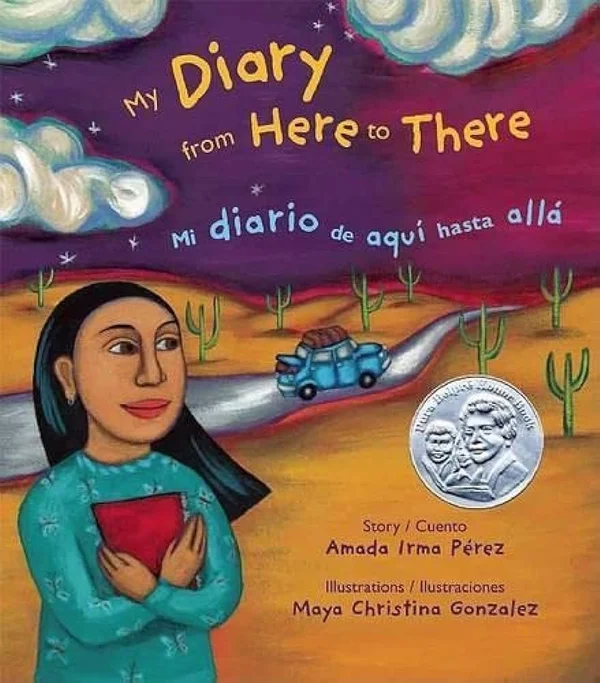
Cover of My Diary from Here to There
My Diary from Here to There
📚
Courage 3rd & 4th Grade
By Amada Irma Pérez

Book Guide

My Diary from Here to There

A story that explores courage and opens a conversation with your child.

★★★★★ Loved by families
This book teaches: Courage. doing what is right even when it is hard.

Before, During & After Reading

Guiding Questions for Parents.

Definition: Courage is the willingness to go beyond fear to face a healthy (not foolish) challenge, even though it  could be painful, risky, or end in failure.   In short: Do good, try hard even when it’s scary. Summary: Amada Irma Perez tells her story in journal entries, describing in detail her family’s exodus from Mexico to Los Angeles. She says her diary is like a best friend with whom she shares her deepest thoughts and feelings. She writes about her fears of an unknown future, how she’ll miss the friends and country she leaves behind. Amanda describes her concern for her papa who goes ahead of the rest of the family to work in the U.S.A. while everyone waits in Mexico for their green cards. Through these journal entries, we learn how immigrants like Amanda muster the courage to face the challenges of starting a new life in a foreign country.     Lesson Objectives: 
  1. This story can be linked to lessons on immigration, exploring themes such as why people leave their country of origin, and what challenges they face as immigrants.  
  2. Students discuss the definition of courage, and why it helps to have courage when faced with the kind of situations Amada Irma Perez encountered. 
  Guiding Questions: 
  1. This book is a diary of a young girl who immigrated from Mexico to the U.S.A. What do you think are the benefits of keeping a journal of one's experiences? 
  2. What did Amanda say about why she kept a journal? If you keep a journal, share about it. 
  3. Why did her family leave Mexico?
  4. What were Amanda’s concerns about leaving her home and traveling to a new country? 
  5. A very worried Amanda asks her dad - “What will happen to us?” - how does he answer her question?
  6. What did the heart shaped stone Amanda took with her symbolize? Do you have something like Amanda’s stone that gives you a special memory?
  7. Do you have a special rock (like Amanda) or something that gives you peace and comfort?    
  8. Do you write in a diary? If not, try keeping a diary for 2 weeks; write about your thoughts, activities and feelings each day. 
  9. “Through our words we keep our memories and culture alive in our diaries and in our hearts.” What do you think this means?  
  10. What are some of the ways that help you feel supported when times are difficult? 
🌿   Virtue Connection: Courage means acting on what is right even in the presence of fear.

Hands-On Practice

Activities for This Story.


Activity: This is a week-long activity, one or two prompts per day. Begin by reviewing the story “My Diary from Here to There” with a focus on the value of journaling as a safe
way to express and explore both positive and more difficult emotions, such as fear and worry. Prompts are given and a word wall is accessible to students as they create and write in their journals. They are invited to share their entries with their classmates, but it’s not a requirement. 

Materials needed: Notebooks or paper (both lined and blank) for making journals; materials for decorating and writing and drawing; a word wall with vocabulary that fits this activity: afraid, fears, worry, calm, happy, unafraid, etc. 


Directions: Re-read the story “My Diary from Here to There” or just review it. Explain that students will create a journal with entries about specific topics. They will be given prompts and will respond to the prompts with words and illustrations (optional). Explain how writing about our feelings can help us deal with our fears and anxieties and will also help us remember the times when we’ve been successful at overcoming a difficulty. Tell them to write at least a paragraph for each prompt, and after that they can make an illustration that goes with the prompt. The journals will be confidential, but students will be invited to share what they wrote if they want. 


Prompts: Do one or two each day. Before they start writing, guide a discussion on the prompt, ask for suggestions from students, and give them some ideas. Assist any students who get stuck. Explain that it’s important to be honest and not criticize yourself when you are writing - it’s okay to have fears and worries, and writing about them will help. Point out the word wall and tell them to let you know if they want you to add words to it. 
  • Describe a place where you feel happy and safe. How does that place make you feel unafraid and calm? 
  • Describe a time when you were worried. What happened and where in your body did you feel that worry - stomach, chest, throat? 
  •  Write about your strengths, what you like to do, what skills you have. Describe how it makes you feel when you remember your strengths. 
  • Everyone has fears. Describe your fears ( spiders, heights, the dark, etc) and how those fears affect you - do they keep you from doing things you’d like to do? 
  • What do you do to calm your fears? 
  • Write three positive statements you could say to yourself when feeling afraid. If you can’t think of anything, what song could you sing that will help you feel courageous? Write some of the lyrics in the song in your journal. 


Wrap-up: Explain that the purpose of this activity is to learn about our fears and worries by journaling. As we understand what makes us afraid or nervous, we can take action to become less afraid, less nervous. Journaling can also help us prepare to talk about what bothers us with our parents or a trusted adult, a teacher, coach, or grandparent.

About the Story.

This guide is part of the Values & Virtues library, a free collection of 400+ book guides and activities organized around 12 core virtues for children from pre-K to 6th grade. Each guide includes Guiding Questions designed to open a real conversation with your child in 10 minutes or less.

Read-aloud video · Best with headphones
Find this book at your library or bookstore →

Explore more guides for 3rd & 4th Grade.