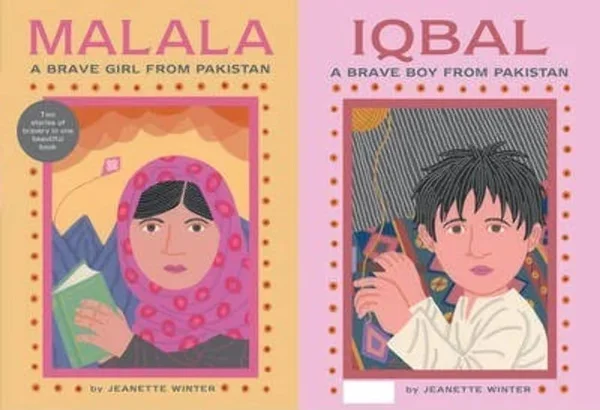
Cover of Malala and Iqbal
Malala and Iqbal
📚
Integrity 5th & 6th Grade
By Jeanette Winter

Book Guide

Malala and Iqbal

A story that explores integrity and opens a conversation with your child.

★★★★★ Loved by families
This book teaches: Integrity. doing what is right when no one is watching.

Before, During & After Reading

Guiding Questions for Parents.

Definition: Integrity is the practice of living consistently by a code of strong moral principles which includes being honest, respectful and responsible all the time, whether you’re seen or unseen.   In short: Do the right thing, even when no one's looking.   Summary: This book features the story of two young activists from Pakistan. Their bravery in the face of great danger inspires us all. When the Taliban discourages girls from going to school, Malala refuses to cooperate, attends school and speaks out against this unfair restriction. As a consequence of her activism she is attacked and seriously wounded. Out of concern for her safety, she leaves Pakistan and continues to bravely speak her truth. Malala was nominated for the Nobel prize in 2013.   Iqbal’s parents live in poverty and when they receive a loan, they are forced to allow their four year old son to work without pay in a carpet factory. Eventually Iqbal finds out that the law about bonded work was rescinded and all loans were forgiven. Liberated Iqbal goes to school, becomes an activist - he travels in Pakistan and the USA and gives speeches about children’s rights. Tragically, due to his activism for children’s rights, the teenager is shot and killed in Pakistan. Eight hundred people attend the funeral to mourn this brave boy’s death and celebrate his accomplishments.    Lesson Objectives: 
  1. Students, moved by the bravery and integrity of these two Pakistanis, will be more inclined to support causes that strive to do away with unfairness, especially toward children. 
  2. This story can be a link to academic studies, especially the history of children’s rights in their country of origin. 
  3. Teachers can guide students to research how they can help underprivileged children in their communities. 
  Guiding Questions: 
  1. The Taliban rulers do not support the rights of women and children. How did this affect Malala’s childhood? 
  2. Malala believed in her rights so much she was willing to take risks. What happened to her? 
  3. Do you think that all children in every country should have the right to an education? 
  4. Going to school was so important to Malala and Iqbal so much that they were willing to take serious risks to win that right. How does going to school help you now and how will it help you when you’re a grownup?   
  5. Did you know that children in some countries, even as young as four years old, have to work instead of going to school? What do you think about that? 
  6. Malala and Iqbal’s beliefs about fairness and access to education gave them the courage to speak about their beliefs in front of large audiences, even though they were children. What are your thoughts about that? 
  7. Why do you think the Taliban didn’t want girls to get an education? 
  8. Why do you think the carpet merchants took advantage of small children and had them work in their factories? 
  9. Can you think of a way to help children who don’t have some of the benefits you do? If you don’t have any ideas, ask your teacher and your family members. 
  10. What are some examples of how Malala and Iqbal demonstrated integrity, the practice of being honest, respectful and responsible, in the choices they made? 
         
🌿   Virtue Connection: Integrity means doing what is right even when no one is watching.

About the Story.

This guide is part of the Values & Virtues library, a free collection of 400+ book guides and activities organized around 12 core virtues for children from pre-K to 6th grade. Each guide includes Guiding Questions designed to open a real conversation with your child in 10 minutes or less.

Read-aloud video · Best with headphones
Find this book at your library or bookstore →

Explore more guides for 5th & 6th Grade.